
If you inherit a home, a capital gain on its sale can generally be disregarded if the sale settles within 2 years of the date of death. When the estate gets held up, the ATO's Practical Compliance Guideline PCG 2019/5 lets executors and beneficiaries treat that deadline as extended by up to 18 months, without applying to the ATO, if they meet five conditions.
How the 2-year rule works
Section 118-195 of the Income Tax Assessment Act 1997 lets a beneficiary, or the trustee of a deceased estate, disregard a capital gain or loss when they sell a home they inherited. It applies to a dwelling that was either:
the deceased's main residence just before they died, and not being used to produce income, where they acquired it on or after 20 September 1985, or
acquired by the deceased before 20 September 1985.
For the full exemption, your ownership interest must end within 2 years of the date of death. For a sale, the clock stops at settlement, not when the contract is signed. The exemption also covers up to 2 hectares of land around the home.
The 2-year limit does not apply if, from the date of death until the sale, the home was the main residence of the deceased's spouse, someone with a right to occupy it under the will, or the beneficiary who sold it.
Why 2 years is often not enough
Estates rarely run to a timetable. Wills are challenged, a surviving partner may have a life interest in the home, and buyers sometimes pull out before settlement. The law allows for this: the Commissioner of Taxation can extend the 2-year period.
The ATO generally allows more time where the home could not be sold and settled within 2 years because of reasons beyond your control that lasted for a significant part of those 2 years. Before PCG 2019/5, getting an extension meant applying to the ATO. The guideline added a safe harbour: if you meet its conditions, you can manage your tax affairs as if the ATO had already granted the extension.
The safe harbour: five conditions
You can rely on the safe harbour only if you meet all five conditions:
More than 12 months of qualifying delay. In the first 2 years after the death, more than 12 months went on dealing with one or more of the qualifying circumstances listed below.
Prompt listing. The home was listed for sale as soon as practically possible after those circumstances were resolved, and the sale was actively managed through to completion.
Settlement within 12 months. The sale settled within 12 months of the home being listed.
No material adverse factors. None of the excluded reasons for delay listed below played a material part.
No more than 18 months extra. The extension you need beyond the 2-year period is no more than 18 months.
That caps the safe harbour at 42 months (3½ years) from the date of death. If a contract falls through for reasons outside your control and you relist the home, the 12-month period in condition 3 restarts from the relisting, but the 42-month cap still applies.
If the ATO later reviews a sale that relied on the safe harbour, it will check these conditions, including the 18-month limit. It will not spend time deciding whether it would actually have granted the extension. Keep records that support each condition.
Delays that count, and delays that rule you out
Qualifying circumstances
At least one of these must have taken more than 12 months to resolve:
the will, or ownership of the home, is challenged
a life tenancy or other equitable interest under the will delays the sale
the complexity of the estate delays the completion of its administration
settlement is delayed, or the contract falls through, for reasons outside your control
government restrictions on real estate activity in response to COVID-19
A complex estate can include one where the home secures the deceased's business debts and those arrangements take time to untangle.
Delays that rule you out
None of these can have been a material cause of the delay:
waiting for the property market to improve
renovating or refurbishing the home to improve the sale price
the trustee or beneficiary finding it inconvenient to organise the sale
unexplained periods of inactivity by the executor
The ATO's own examples show where people get caught. Letting a family member live in the home when the will gives them no right to occupy it is a choice within the trustee's control, so that delay does not qualify. Neither does subdividing the land to lift the price, even if the council holds things up.
Repairing storm damage may be outside your control, but adding significant renovations at the same time can cost you the safe harbour. So can leaving the home vacant for months after a dispute is settled while the family decides what to do.
A worked example
This example is adapted from Example 5 in PCG 2019/5. A father leaves his home, which he bought before 1985, to his two adult children in equal shares.
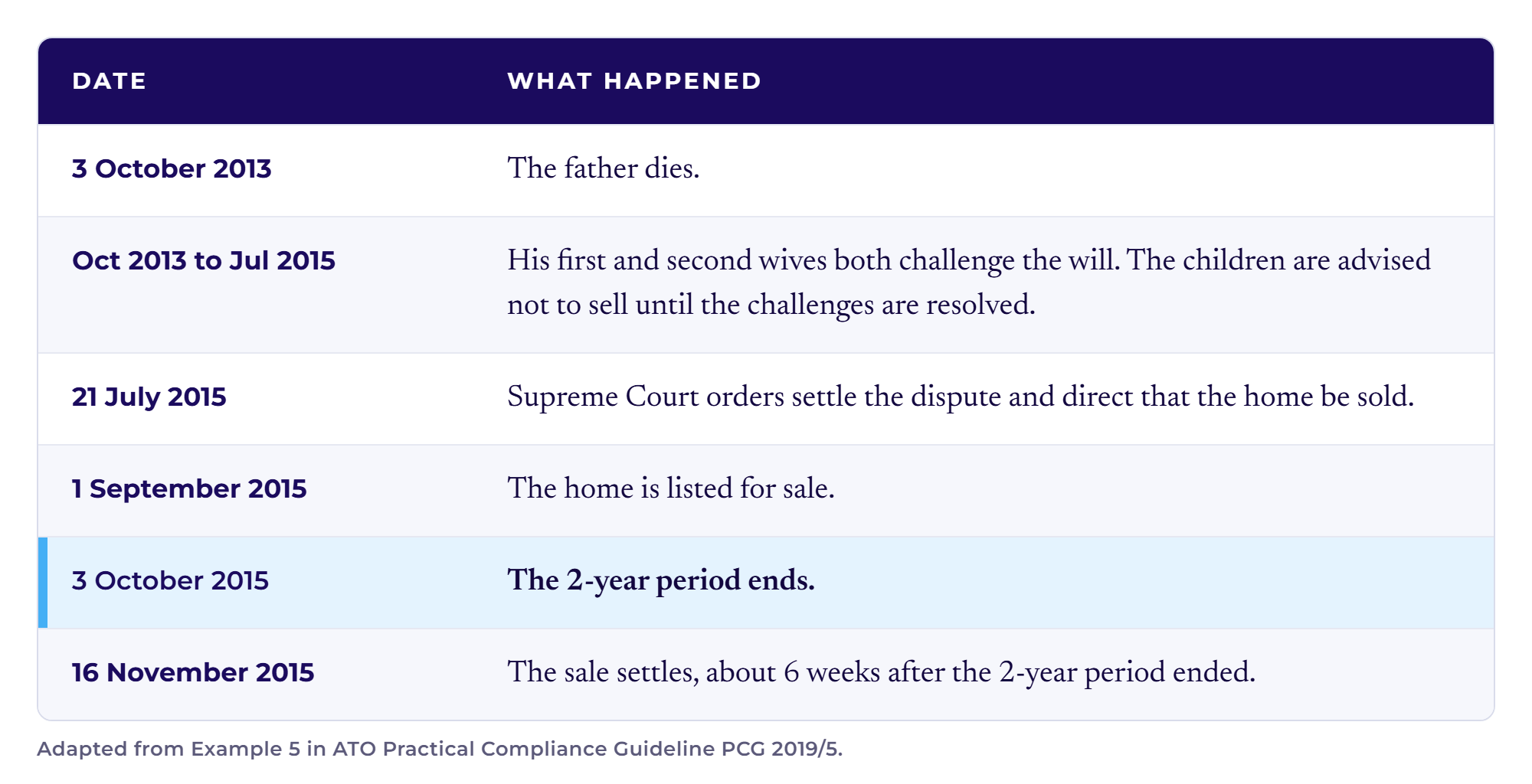
The children can rely on the safe harbour. The will challenges took up more than 12 months of the first 2 years, and the home was listed about 6 weeks after the court orders. The sale settled within 12 months of listing, no adverse factors were present, and they needed far less than 18 months of extra time.
Outside the safe harbour: asking the ATO
If you don't meet every condition, or need more than 18 months, you can still ask the Commissioner to extend the period. Since 1 April 2026, you do this by writing to the ATO rather than through the private ruling process. Tax agents and individuals with an ABN can lodge through ATO online services, and individuals without an ABN send a signed letter by fax or post.
The ATO weighs all the factors, favourable and adverse. The qualifying circumstances above count in your favour, and the excluded reasons count against you. It may also consider:
the sensitivity of your personal circumstances, and those of the deceased's other surviving relatives
how hard it was to locate all the beneficiaries needed to prove the will
any period the home was used to produce income
how long you held the home
What caused the delay matters more than how long it was, and the size of the gain is irrelevant. The ATO will not extend the period for even a short delay with no relevant reason. A long delay can still be extended where relevant circumstances caused it and lasted for the overwhelming majority of the period.
In one of the ATO's examples, an executor's serious illness kept him from the estate for a long stretch. That falls outside the safe harbour, but the ATO said it would take the illness into account.
Your request should include a timeline of events from the date of death to the sale, explaining why the home was not sold within 2 years. Include a copy of the will and the contract and settlement dates. The ATO usually decides after settlement, once the full facts are known.
Two cautions before you apply:
An extension also disregards losses. If granted, it applies whether the sale makes a gain or a loss, so a capital loss is disregarded too.
If no extension applies, the gain is generally worked out using the home's market value at the date of death as its cost base. A partial exemption may still be available under section 118-200.
Practical tips for executors and beneficiaries
Diarise the 2-year date from day one. Work back from settlement, not exchange of contracts.
Keep a running file. Record the date of each event, and keep correspondence, court documents, agency agreements and a note explaining every pause.
List as soon as the obstacle is resolved. Waiting for spring or a stronger market counts against you.
Limit work on the home to essential repairs. Renovating to lift the price can cost you the safe harbour.
Think before letting family move in. Unless the will gives them a right to occupy the home, the delay is treated as your choice.
If a sale falls through, record why and relist promptly. The 12-month clock restarts from the relisting, within the 42-month cap.
Get advice early. A deadline is easier to plan around than to explain after it has passed.
If you are administering an estate or have inherited a home, speak to our team early about the timing of the sale and whether the safe harbour or an ATO extension may apply.
Sources
PCG 2019/5: Capital gains tax and deceased estates – the Commissioner's discretion to extend the 2-year period (ATO, last updated 1 April 2026)
Request discretionary extension to sell an inherited dwelling (ATO, published 1 April 2026)
This article is general information only and is not legal or tax advice. Whether the exemption, the safe harbour or an extension applies depends on your circumstances, so please get advice before acting.
