Parliament has passed a 30% minimum tax on discretionary trusts, starting 1 July 2028. Genuine testamentary trusts are largely carved out, and a late Senate amendment means most existing wills will not need to be rewritten. The carve-out has limits, though, and two dates matter.
What passed
Two Bills carry the recent changes - the Treasury Laws Amendment (Tax Reform No. 3) Bill 2026 finally passed both Houses on 26 November 2026, a day after its companion rates Bill but both currently await Royal Assent.
For income years starting on or after 1 July 2028, the trustee of a discretionary trust must pay at least 30% tax on the trust's net income. Individual beneficiaries receive a tax offset for that tax, but any excess is not refunded, which hits beneficiaries on low incomes. Companies receive no offset.
Genuine testamentary trusts stay outside
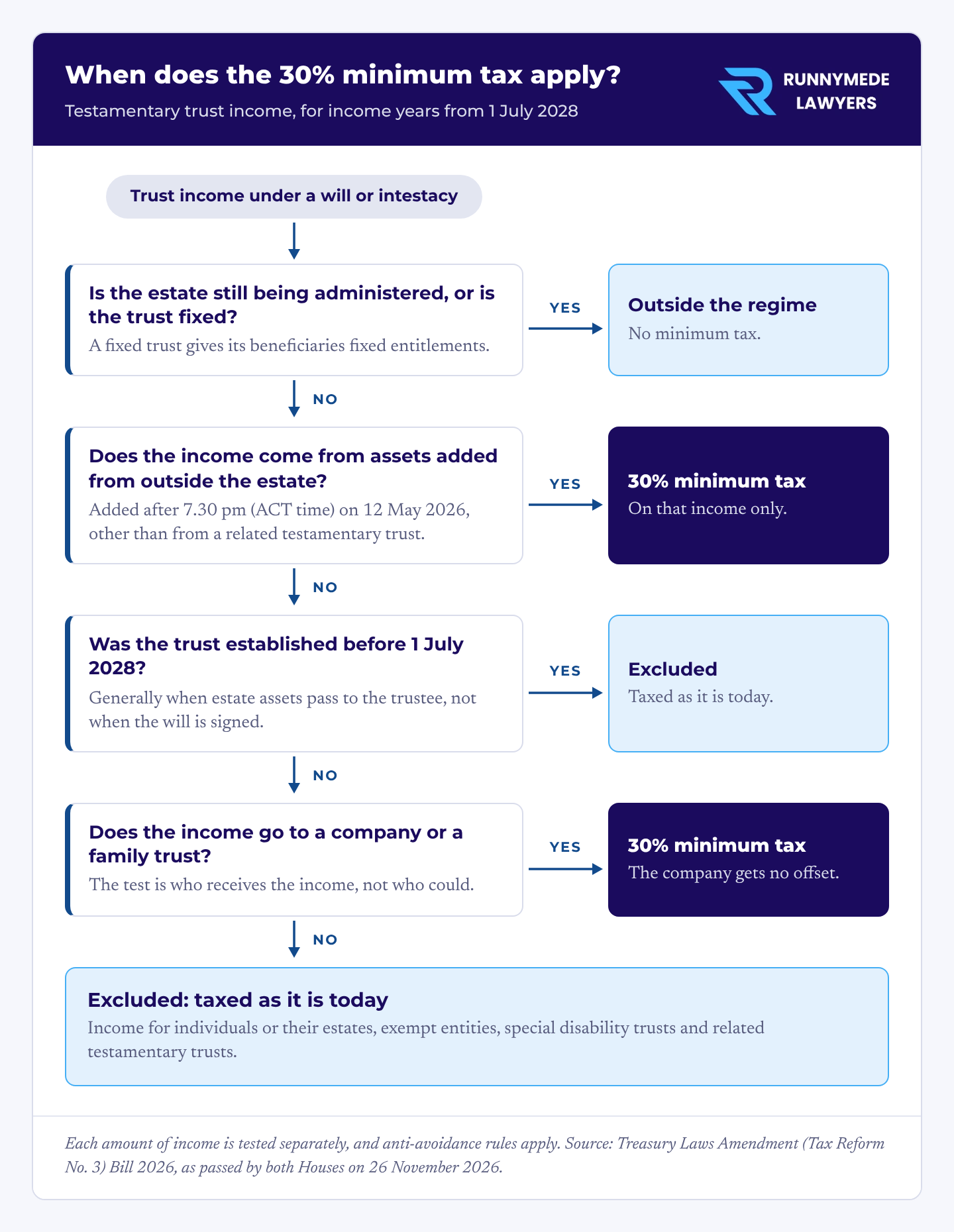
A deceased estate under administration is not caught. Nor is a testamentary trust that gives its beneficiaries fixed entitlements.
A discretionary testamentary trust is caught in form but spared in substance. Its income is excluded if the trust arose under a will, codicil, intestacy or court order and the income comes from assets of the deceased estate, or from what those assets later earn or are reinvested into (section 101AD, Income Tax Assessment Act 1936).
Excluded income is taxed as it is today. Beneficiaries pay at their own marginal rates, and children are still taxed at adult rates on it, not the penalty rates that usually apply to minors.
Where the 30% still applies
Outside assets. Income from property added from outside the estate after 7.30 pm (ACT time) on 12 May 2026, Budget night. Transfers from a related testamentary trust are allowed.
Companies and family trusts. For a trust established on or after 1 July 2028, income that goes to a company or a family trust. The trustee pays 30%, the company gets no offset, and the company still pays its own tax on that income. Trusts established before that date are not subject to this limit.
Contrived arrangements. Income or assets brought into the trust under a scheme with a more than incidental purpose of obtaining the exemption.
At a glance
The flow below shows how each amount of a testamentary trust's income is tested.
Most wills will not need redrafting
As introduced, a post-2028 trust risked losing the exemption simply because its terms allowed a company or another trust to benefit. The Senate changed that. The test now turns on who the income actually goes to, so a wide class of potential beneficiaries does no harm by itself.
Income stays exempt when it goes to an individual, an individual's legal personal representative, a special disability trust, an exempt entity such as a charity, another testamentary trust of the same deceased person, or a related testamentary trust. A related trust includes one under the will of a beneficiary who has since died.
The date that counts is when the trust is established, not when the will is signed. The explanatory memorandum says that is generally when estate assets pass to the trustee. If you are alive on 1 July 2028, the trust under your will is a post-2028 trust, however old the will.
Capital gains
The package also exempts capital gains that individuals make as beneficiaries of genuine testamentary trusts and deceased estates from the separate 30% minimum tax on capital gains, which starts on 1 July 2027. The exemption stops at the trust. A gain made on later selling an asset received from the trust is not covered.
What to do now
Will-makers: you do not need a new will solely because of this law. Get advice if your estate plan relies on paying trust income to a family company or family trust.
Executors and trustees: keep estate assets separate, do not add outside money to a testamentary trust, and record where each asset came from.
Everyone: expect more detail. Further legislation on reporting and administration is coming, and the legislation does not define when a trust is "established".