In Victoria, a lease is a retail premises lease because of how the lease lets the premises be used, not because of what the document is called. If the premises are "retail premises" under the Retail Leases Act 2003 (Vic), mandatory rules apply and the parties cannot contract out of them. If they are not, the lease is an ordinary commercial lease and the parties are largely held to the bargain they wrote.
The line matters more in Victoria than in most States. A retail landlord cannot pass on land tax or its legal costs of preparing the lease, must maintain the structure and plant, and must give a term of at least five years unless the tenant waives it. A commercial landlord faces none of those limits unless the lease says so.
The line is also harder to see. Victoria has no list of retail businesses, and the Act has been applied to a cold storage warehouse and a sand quarry.
This article explains where Victoria draws the line, then compares the two regimes issue by issue. It is the third in a series covering Queensland, New South Wales, Tasmania and Victoria.
When a lease is a retail premises lease
A lease is a retail premises lease if the premises are "retail premises" when the lease is entered into or renewed, and no exclusion applies (sections 4 and 11). Victoria has a single gateway, and it turns on use.
The use test. Premises are retail premises if, under the terms of the lease, they are used, or are to be used, wholly or predominantly for the sale or hire of goods by retail or the retail provision of services. Any area intended for use as a residence is left out of account.
No list and no shopping centre gateway. Queensland and New South Wales prescribe lists of retail businesses, and treat any business in a shopping centre as retail. Victoria does neither. Every lease is tested against the same words.
"Lease" includes a sub-lease and an agreement for a lease (section 3).
What "retail" means
The Act does not define "retail". The courts ask who the ultimate consumer is: are the goods or services used by the person who buys them, or passed on unaltered to someone else?
The buyer does not have to be a member of the public. In IMCC Group (Australia) Pty Ltd v CB Cold Storage Pty Ltd [2017] VSCA 178, the Court of Appeal held that a cold storage warehouse was retail premises. Its customers were mostly businesses, but they were the ultimate consumers of the storage service.
The test reaches well beyond shops. VCAT has applied the Act to a sand quarry on bare land (Phillips v Abel [2019] VCAT 1031). The Victorian Small Business Commission gives further examples of businesses that may be covered:
a supplier of flour to a bakery;
a mechanic servicing a car hire company's fleet; and
a law or accounting firm acting for a university.
Some uses stay outside the test:
Sales to resellers. Goods that the buyer passes on unaltered are not sold to the ultimate consumer, so pure wholesaling is not retail.
Head leases. A head lease is not retail merely because the subleases are. In Izett St Pty Ltd v Applgold Pty Ltd [2021] VCAT 174, a head tenant whose business was subletting to retailers did not hold a retail premises lease.
Minor retail use. The retail use must be the whole or predominant use under the lease.
The words of the lease matter, but they are not decisive. The test looks at use "under the terms of the lease". Even so, a clause saying the Act does not apply carries little weight if the actual use meets the definition (Access Solutions International Pty Ltd v Gamet Pty Ltd [2017] VCC 1563).
Where shopping centres fit
A retail shopping centre is not a gateway in Victoria, but it brings extra rules. Part 8 of the Act applies only to retail premises in a "retail shopping centre".
A centre is a cluster of at least five retail premises with one owner or landlord, in one building or adjoining buildings. It must also be promoted, or generally regarded, as a shopping centre, mall, court or arcade (section 3).
Leases that fall outside the Act
Even where premises pass the use test, the Act and the Minister's determinations take some premises, tenants and leases outside it. If one applies, the lease is a commercial lease.
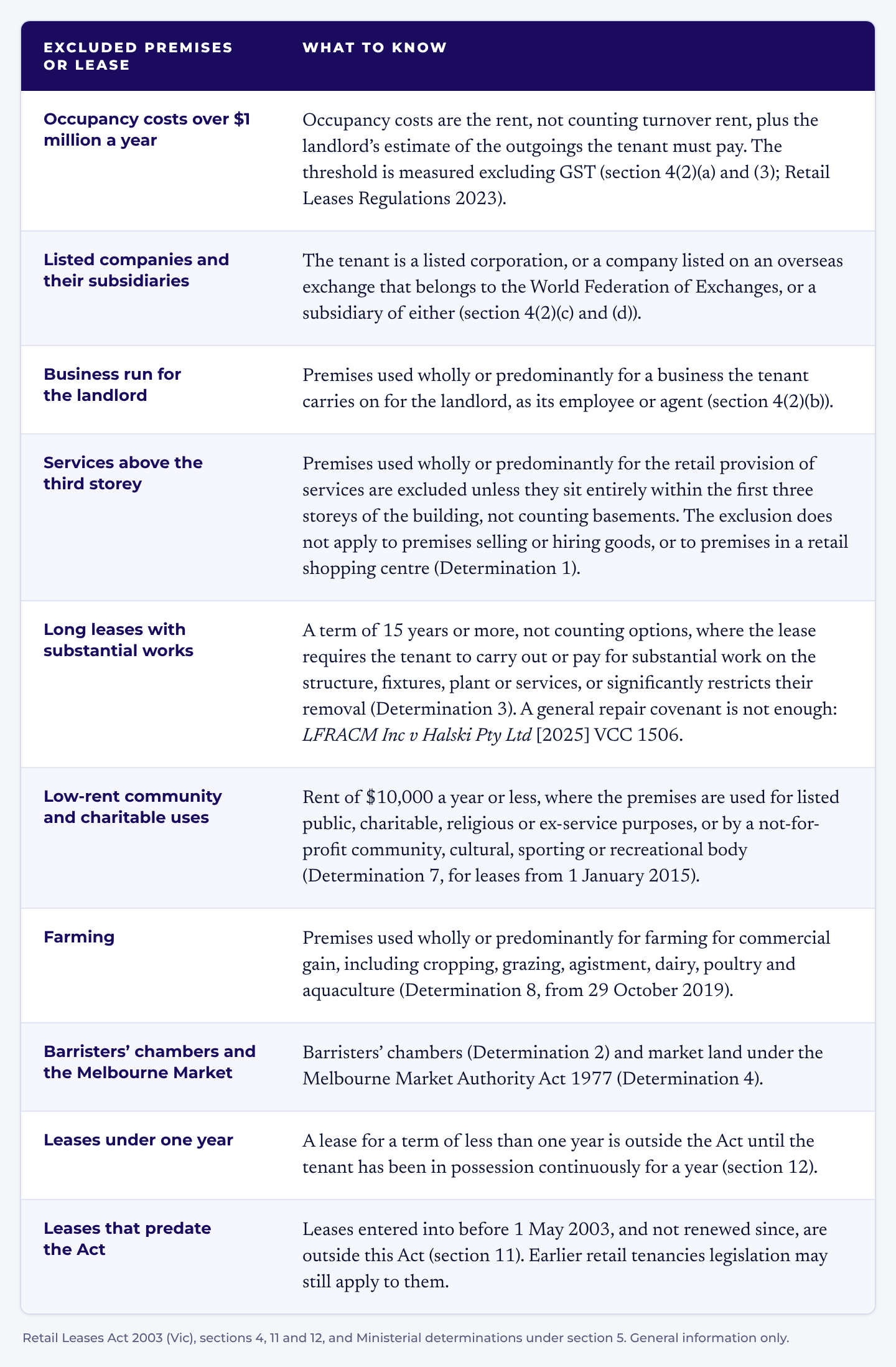
The determinations are made by the Minister under section 5 and are published by the Victorian Small Business Commission.
A short lease does not stay outside the Act indefinitely. Once the tenant has been in possession continuously for one year, the Act applies from that day, with modified disclosure rules (section 12).
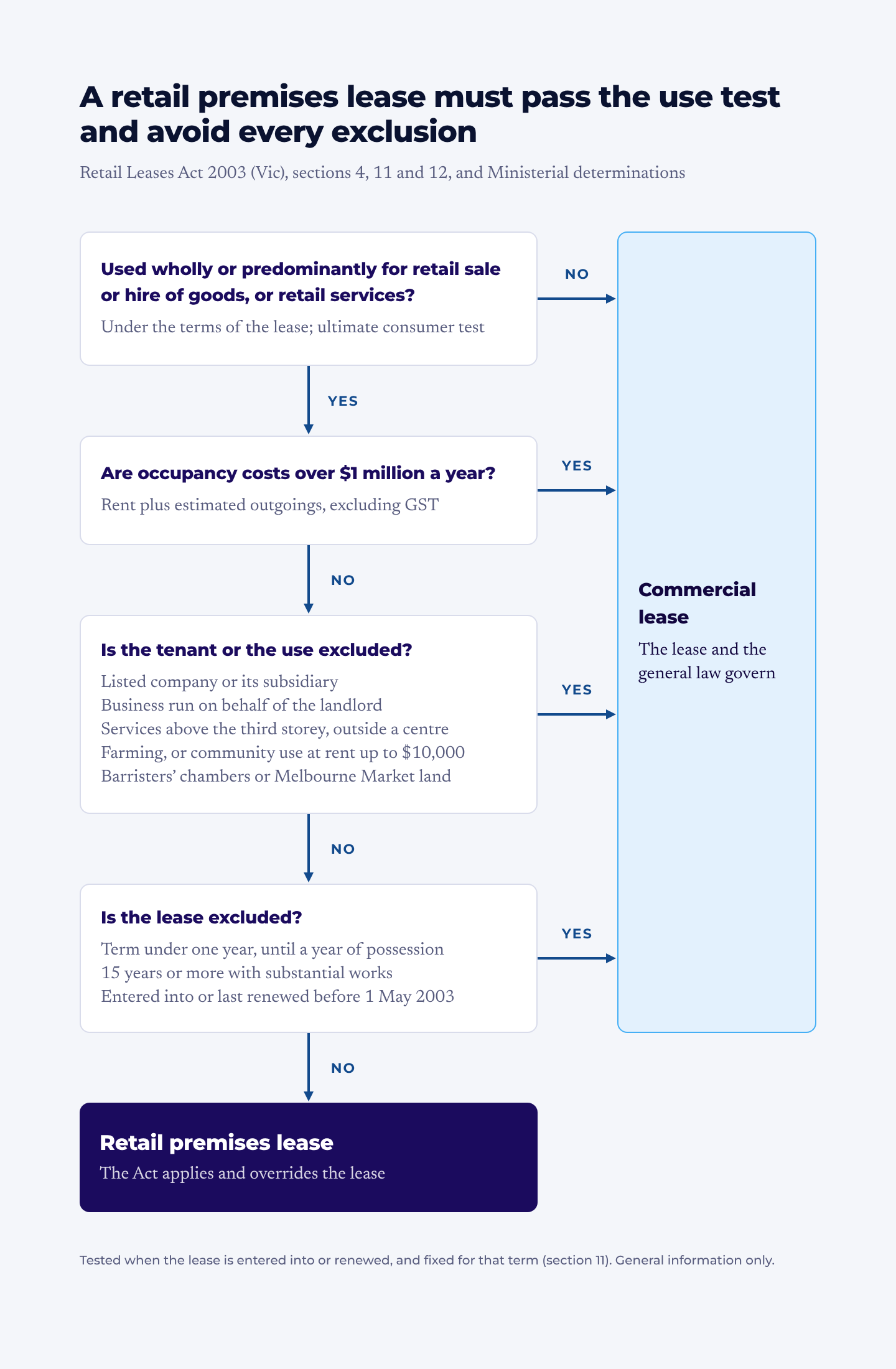
Only a lease that passes the use test and clears every exclusion is a retail premises lease.
When the test is applied
The test is applied when the lease is entered into, and again each time it is renewed. The answer then holds for that term.
Section 11 says the Act applies only if the premises are retail premises "at the time the lease is entered into or renewed". Under section 7, a lease is entered into at the earliest of three events: the tenant takes possession with the landlord's consent, the tenant begins to pay rent, or all parties have signed.
A lease cannot leave the Act during its term. In Verraty Pty Ltd v Richmond Football Club Ltd [2020] VSCA 267, the tenant's occupancy costs rose above $1 million part-way through the term. The Court of Appeal held that the lease remained a retail premises lease, so the landlord could not begin recovering land tax.
Renewal is a fresh test. In Tiba Kebab Pty Ltd v G8 Education Limited [2025] VCAT 987, a listed company had taken an assignment of a 2008 lease and later renewed it. VCAT held that each renewal is a new lease for this purpose, so the Act did not apply to the renewed terms.
A lease can therefore cross the line at renewal. Before an option is exercised, both parties should recheck the occupancy costs, the tenant's corporate status and the permitted use.
Short leases are the statutory exception to the fixed-for-the-term rule. A lease of less than one year comes under the Act on the day the tenant completes a year of continuous possession (section 12).
The label does not decide the question. A term that conflicts with the Act, or tries to exclude it, is void, whether it sits in the lease or in another agreement (section 94).
Retail premises lease and commercial lease compared
A retail tenant's protections come from the Act, while a commercial tenant has only what it negotiates into the lease. Section numbers refer to the Retail Leases Act 2003 unless another Act is named.
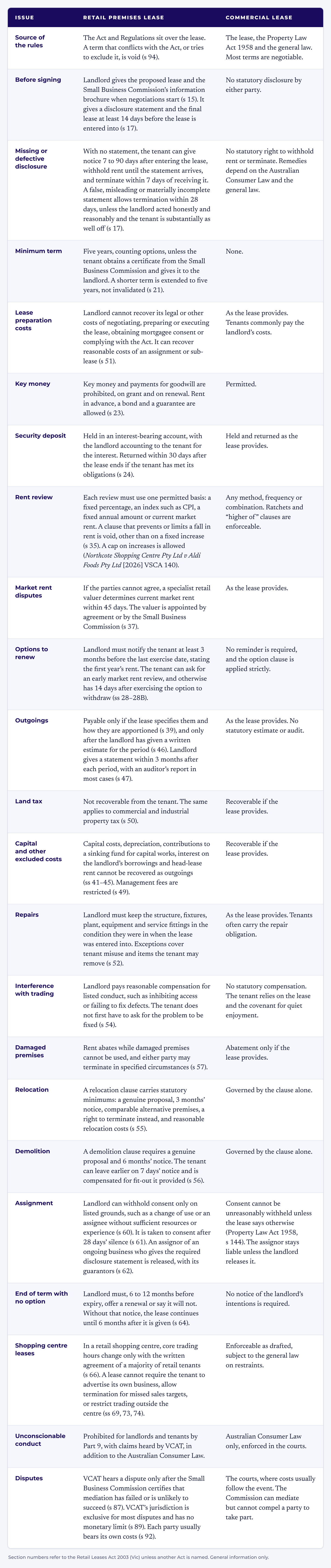
Some rules are common to both kinds of lease. The Australian Consumer Law prohibits misleading and unconscionable conduct, and unfair terms in standard form small business contracts.
Forfeiture is also common ground. A landlord must serve a notice under section 146 of the Property Law Act 1958 before re-entering for a breach other than non-payment of rent. Section 94A of the Retail Leases Act confirms that this applies to retail premises leases.
What may change
The Victorian Act has been stable since mid-2024, but the wider picture is moving.
The Act was last amended on 1 July 2024, when landlords were barred from recovering commercial and industrial property tax from retail tenants. The Retail Leases Regulations 2023 have applied since 15 April 2023.
The courts settled the rent cap question in June 2026. In Northcote Shopping Centre Pty Ltd v Aldi Foods Pty Ltd [2026] VSCA 140, the Court of Appeal refused leave to appeal and confirmed that a cap on a rent increase is not a second method of review (case note).
The Small Business Commission has also issued a new information brochure for tenants. Landlords must use it for lease negotiations that start on or after 1 July 2026 (announcement).
Nationally, the Commonwealth Treasury consulted between August and October 2026 on harmonising retail tenancy rules across the States and Territories. It asked where greater consistency would help and has not announced any proposals. A national approach would have to reconcile Victoria's open-ended use test with the list-based tests used in Queensland and New South Wales.
This article is general information only and is not legal advice. It states the law as at 23 November 2026.