
The short answer
A warranty is a promise that something is true. An indemnity is a promise to pay if a particular loss happens.
That single difference drives everything else: what you have to prove, how much you get back, what defences the other side can run, and how long you have to sue. If a warranty turns out to be false, you sue for damages and prove your loss the hard way. If an indemnity is triggered, you claim the money the clause says you are owed.
The two often sit side by side in the same contract, sometimes in the same sentence. They are not interchangeable.
The NSW Court of Appeal showed how much turns on it in Zaccardi v Caunt [2008] NSWCA 202. A buyer of land crossed out the indemnity in the common clause where the buyer warrants that no agent introduced it to the property, but left the warranty itself in place. The court held that was a material change to the contract, for three reasons: the indemnity was measured differently, its limitation period was likely to run longer, and it expressly survived completion ([33]–[36]).
Warranties: a promise about the facts
A warranty is a contractual statement that something is true, usually as at signing and often again at completion. The accounts are accurate. There is no litigation on foot. The equipment is in sound working order.
If the statement is false, the contract is breached and you can claim damages. The ordinary rules of contract damages then apply, and each of them can cut down what you get back:
• Causation: you must show the breach caused your loss.
• Remoteness: the loss must be of a kind the parties would reasonably have contemplated (the rule in Hadley v Baxendale (1854) 9 Ex 341).
• Mitigation: loss you could reasonably have avoided is not recoverable.
Damages aim to put you where you would have been if the statement had been true (Commonwealth v Amann Aviation Pty Ltd (1991) 174 CLR 64 at 80). Where the warranty goes to the value of what you bought, the usual measure is the gap between what it would have been worth as warranted and what it was actually worth. In principle that is not the price you paid less its true value, which is the measure for misleading conduct, although the price is often used as evidence of the warranted value (DTZ Worldwide Ltd v AIG Australia Ltd [2025] NSWSC 12 at [166]). Nor is it simply the cost of fixing the problem you found.
That gap is hard to prove. In DTZ, a buyer of a property services group claimed about $234 million from its warranty and indemnity insurers. Most of the case failed. The buyer proved one breach: answers given about a facilities management contract suggested all was well when its cleaning costs had blown out ([159]–[164]). The court added that accounting errors with no effect on the business’s future cash flows would not have changed its value, so would have been worth nothing in damages ([201]). The buyer had no expert evidence valuing the breach it did prove, and the court would not “pluck a figure out of the air” ([198]). Any loss was well below the point at which the remaining insurers’ cover began, so the claim against them was dismissed ([200], [202]).
One naming trap: in the law on classifying contract terms, a “warranty” also means a minor term whose breach gives damages but no right to terminate. In a sale agreement or commercial contract, it almost always means a statement of fact.
Indemnities: a promise to pay
An indemnity is a promise to keep the other party harmless against a defined loss. It is a primary obligation: the indemnifier is directly on the hook, not merely answering for someone else’s default (Canty v PaperlinX Australia Pty Ltd [2014] NSWCA 309).
The trigger is whatever loss or event the clause describes, which need not be a breach by anyone. What you recover depends simply on whether your loss falls within the scope of the clause (Zaccardi at [33]).
That is why parties fight over them. Compared with a warranty claim, an indemnity can:
• Sidestep remoteness. Generally, the Hadley v Baxendale limits do not cap recovery under an indemnity. The test is the scope of the clause, so the exposure can be wider than for damages (Zaccardi at [33]). In 2025 the Queensland Court of Appeal noted that remoteness and mitigation may limit a damages claim “in a way not relevant to the claim for indemnity” (Shamrock Civil Engineering Pty Ltd v Cleanaway Solid Waste Pty Ltd [2025] QCA 178 at [95(e)]).
• Skip mitigation. There is generally no duty to mitigate unless the clause imposes one, although courts may confine recovery to losses fairly and reasonably incurred (Scottish & Newcastle plc v Raguz [2008] 1 WLR 2494).
• Dodge consequential loss exclusions. If the claim is characterised as a debt rather than damages for breach, an exclusion aimed at breach of contract may not apply (Caledonia North Sea Ltd v London Bridge Engineering Ltd [2002] 1 Lloyd’s Rep 553).
• Start the limitation clock later. Time runs from when the loss is suffered, not from when the promise was made, and depending on the drafting may not start until a demand to pay is refused (Zaccardi at [34]).
The counterweight: courts read indemnities strictly. If the clause is genuinely ambiguous, including about how far it reaches, the doubt is resolved in favour of the party giving it (Andar Transport Pty Ltd v Brambles Ltd (2004) 217 CLR 424; Bofinger v Kingsway Group Ltd (2009) 239 CLR 269). Loose drafting cuts both ways.
Side by side
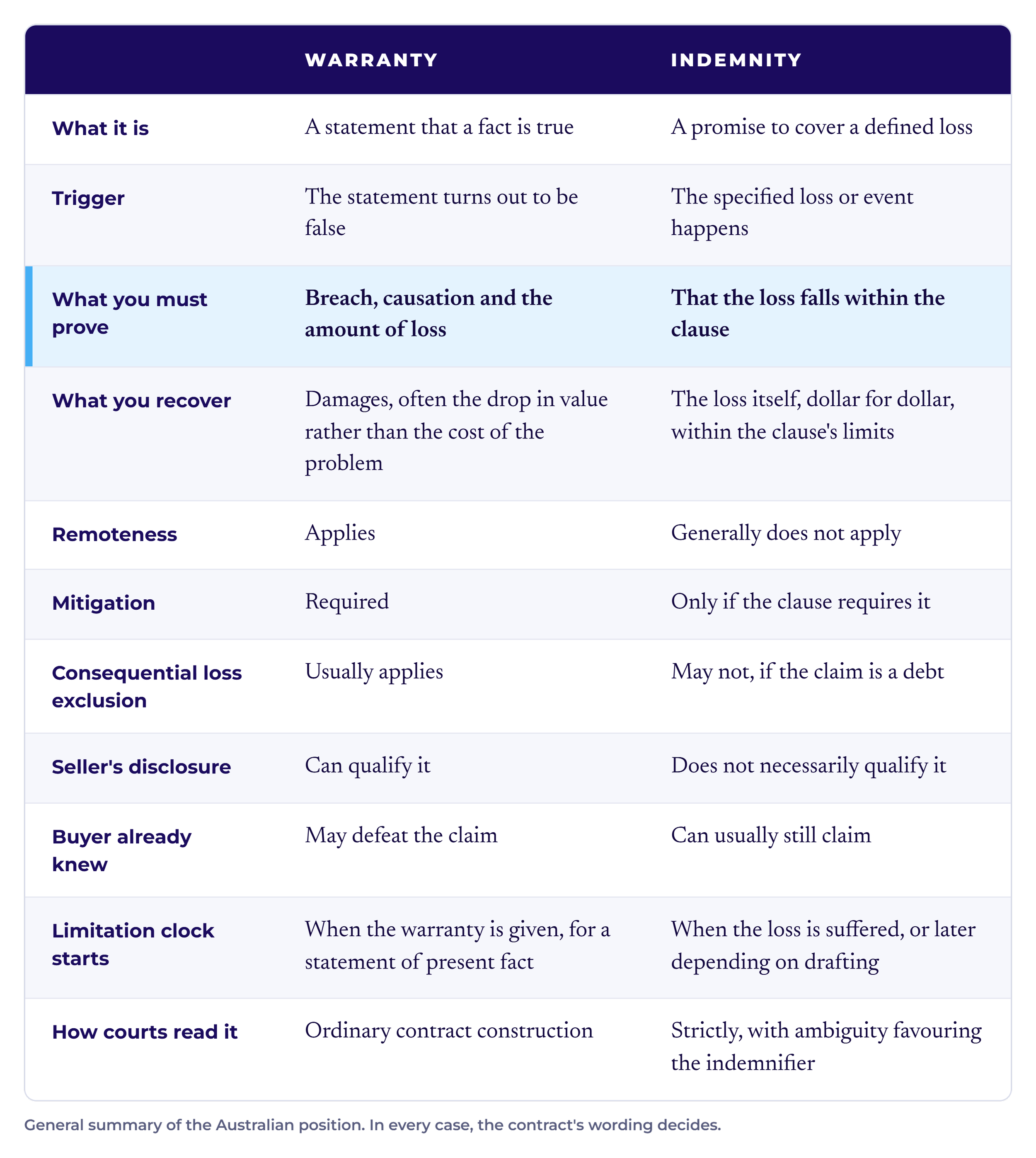
In NSW the limitation period is generally six years for a simple contract and 12 years if the promise is in a deed (Limitation Act 1969 (NSW) ss 14(1)(a), 16,).
Where deals go wrong
If you are giving an indemnity:
1. Tie it to fault. Limit it to loss caused by your negligent, wrongful or unlawful acts, and reduce it to the extent the other party contributed.
2. Choose the link words carefully. “Arising out of” and “in connection with” are read broadly and need no direct cause (CSR Ltd v Adecco (Australia) Pty Ltd [2017] NSWCA 121). “Caused by” or “directly resulting from” give you more protection. Broad words still have limits. In Shamrock, a contractor’s indemnity for damage arising “in the course of” its works could not be claimed for almost $31 million of flood damage merely because heavy rain hit the unfinished works while the contract was running. Coincidence of time and place was not enough ([56], [68]).
3. Think twice before indemnifying your own breach of contract. It can strip out the remoteness and mitigation rules that would otherwise limit a damages claim.
4. Make exclusions reach the indemnity. If loss of profit is off the table, say so “including under any indemnity”. Otherwise the indemnity may be argued to sit outside it.
5. Cap it, add a mitigation duty, and decide whether it survives termination.
6. Check your insurance. Liability policies often exclude liability you take on by contract, so your indemnity may be uninsured.
If you are getting one:
1. Use each tool for its job. Warranties give broad comfort about the business. Indemnities cover specific, known risks, such as a disclosed dispute, a tax exposure, or contamination that may not surface until the warranty claim period has ended.
2. Check the limitations. Caps, thresholds and claim periods negotiated for warranties do not automatically apply to indemnities, and an 18-month window for warranty claims is not unusual. Make the contract say which applies to what.
3. Read the qualifiers. “So far as the seller is aware” can hollow out a warranty. In DTZ, an awareness-qualified warranty was breached only where a named executive actually appreciated the problem. Knowing facts from which a reasonable person would have drawn the conclusion was not enough ([131]–[133], [153], [163]).
4. Have them repeated at completion, and make them survive it. A warranty given only at signing says nothing about what changes before settlement. In DTZ, a data-room answer that was not corrected by completion was treated as continuing until then, and leaving it uncorrected was a breach ([159]). On a sale of land, terms can also merge into the transfer at completion unless the contract shows they are meant to survive (Zaccardi at [35]).
5. Watch “warrants and indemnifies”. A clause that does both can give indemnity-style recovery when a statement proves false. In Westina Corporation Pty Ltd v BGC Contracting Pty Ltd [2009] WASCA 213, a hire agreement’s warranty clause carried its own indemnity.
6. Make sure the other side can pay. An indemnity from a shell company is worth little without a guarantee or insurance behind it.
7. Cover your people. An indemnity in favour of a company’s officers and employees may not protect them directly, because they are not parties. Holding the benefit on trust for them is one fix.
8. If there is W&I insurance, treat the insurer as a potential opponent. Buyers often give up warranty claims against the seller and claim on the policy instead (DTZ at [6]). In Asahi Holdings (Australia) Pty Ltd v Pacific Equity Partners Pty Ltd (No 2) [2014] FCA 481, a buyer sent its lawyers’ privileged analysis to its W&I insurer to support a claim. Because the insurer’s interests lined up with the sellers’, privilege was lost against the sellers too, and the buyer had to hand the full report over ([69]–[71], [82], [95]). A “Privileged and Confidential” stamp carried little weight ([85]). Get confidentiality undertakings in writing first.
Either way, do not cut and paste. Courts construe each indemnity on its own words, and decisions on differently worded clauses are of limited help (Erect Safe Scaffolding (Australia) Pty Ltd v Sutton [2008] NSWCA 114).
The bottom line
A warranty tells you what you are buying. An indemnity tells you who pays when a specific thing goes wrong.
For every promise you are relying on, ask one question: if this turns out to be wrong, do I want to prove damages in court, or send a bill? The answer tells you which one you need.
The time to get this right is before you sign. If you are negotiating a sale, supply or services agreement with warranties or indemnities in it, talk to us first.
This article is general information only and is not legal advice.
