
In New South Wales, a lease is a retail shop lease because of the business the premises are used for or the centre they sit in, not because of what the document is called. If a lease meets the definition in the Retail Leases Act 1994 (NSW), mandatory rules apply and the parties cannot contract out of them. If it does not, it is an ordinary commercial lease and the parties are largely held to the bargain they wrote.
The line matters because the two regimes allocate cost and risk differently. A retail landlord must give a disclosure statement at least seven days before the lease is entered into, cannot charge the tenant for preparing the lease, and is limited in how rent can be reviewed. A commercial landlord faces none of those limits unless the lease says so.
This article explains where New South Wales draws the line, then compares the two regimes issue by issue. It is the second in a series covering Queensland, New South Wales, Tasmania and Victoria.
When a lease is a retail shop lease
A lease is a retail shop lease if it grants a right to occupy a "retail shop" and neither the shop nor the lease is excluded. Premises are a retail shop if they pass either of two tests in the section 3 definition.
Gateway 1: the premises are in a retail shopping centre. The tenant's business does not have to be on the prescribed list. A solicitor or a medical practice in a shopping centre can hold a retail shop lease.
Gateway 2: the premises are used, or proposed to be used, wholly or predominantly for a prescribed business. Location does not matter. A stand-alone café, or a hairdresser in a suburban shopping strip, is a retail shop.
"Lease" is defined widely. It covers any agreement granting, for value, a right to occupy premises for use as a retail shop, whether or not the right is exclusive and whether the agreement is written, oral or implied. Calling the document a licence does not take it outside the Act.
"Premises" includes a defined area in a building or other permanent structure. A kiosk in a mall can therefore be a retail shop.
What makes a retail shopping centre
A cluster of premises is a retail shopping centre only if it has all four attributes in the section 3 definition:
at least five of the premises are used wholly or predominantly for prescribed businesses;
all the premises have one owner, one landlord or head landlord, or are lots in a single strata plan;
the premises are in one building, or in two or more buildings that adjoin or are separated only by common areas or other areas owned by the owner of the shops; and
the cluster is promoted as, or generally regarded as, a shopping centre, mall, court or arcade.
A strip of six shops with six different owners is not a retail shopping centre, however much it looks like one. Each shop is tested on its own use under gateway 2. The café is a retail shop, and the accountant next door holds a commercial lease.
Offices above a centre are not automatically part of it. Until 1 July 2017, the Act expressly excluded premises in an office tower forming part of a retail shopping centre. The exclusion was repealed as unnecessary, because a tower is not part of a centre merely by sitting above it (explanatory note).
What counts as a prescribed business
The prescribed businesses are listed in Schedule 1 of the Retail Leases Regulation 2022, which runs to more than 160 entries. Most are described by what the shop sells or does:
Food and drink: cafés, restaurants, takeaway and fast food shops, bakeries, butchers, greengrocers, supermarkets, bottle shops, and small bars holding up to 120 patrons.
Goods: clothing, shoes, furniture, electrical appliances, hardware, jewellery, toys, books, newsagencies, sporting goods and pharmacies.
Services: hairdressers, barbers, beauticians, nail bars, optometrists, dry cleaners, key cutting, travel agencies, pet grooming, and gymnasiums and fitness centres.
Gyms and small bars joined the list when the Regulation commenced on 1 January 2023 (Small Business Commissioner fact sheet).
The list has gaps that matter. It has no entry for professional offices, medical or dental practices, real estate agencies, childcare centres or warehouses, and it expressly leaves out tyre shops. Outside a retail shopping centre, leases to those businesses are commercial leases.
Leases that fall outside the Act
Even where premises are a retail shop, sections 5 to 6B take some shops and some leases outside the Act. If one applies, the lease is a commercial lease.
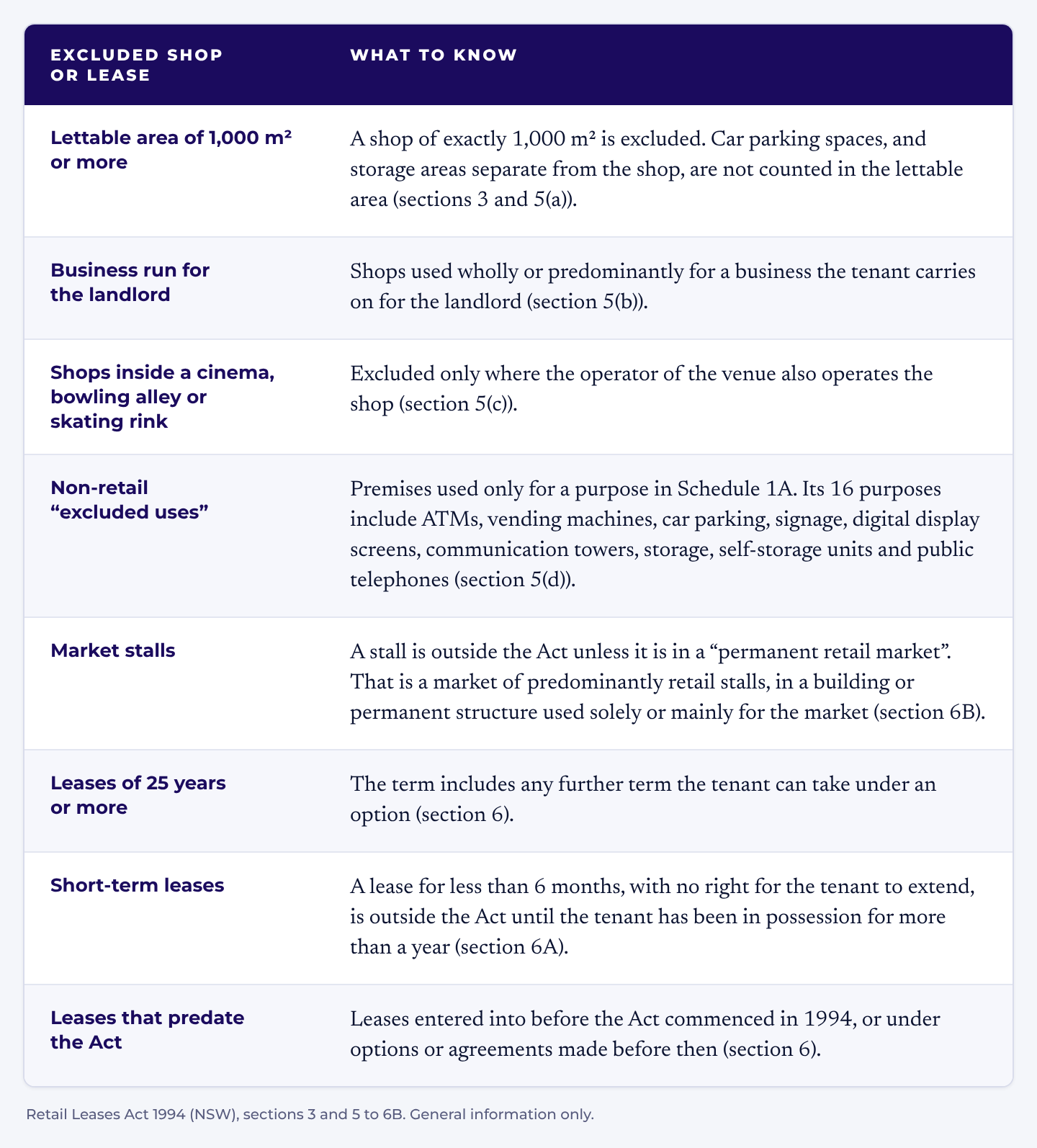
Regulations can exempt further classes of shops and leases, but the Retail Leases Regulation 2022 contains no exemptions.
Two further rules decide whether a lease that starts outside the Act stays there:
Short-term leases roll in. Once a tenant has been in possession, or entitled to it, without interruption for more than one year, the Act applies from that day and to any later lease to the same tenant. The year can be built from successive short leases, renewals or extensions. The disclosure provisions in sections 11 to 12A do not apply to the lease on foot when the year is reached, but they apply to the next one (section 6A).
Changes to the list do not reach back. If premises become a retail shop only because the list of prescribed businesses changes, the Act does not apply to a lease entered into before the change, or under an earlier option or agreement (section 84B). The reverse also holds, so a retail shop lease keeps the Act if its business later leaves the list.
Gyms and small bars are the current example. A gym lease signed before 1 January 2023, outside a shopping centre, remains a commercial lease. Its parties can still use the Act's mediation process, because clause 5 of the Regulation extends that part of the Act to them.
The test at a glance
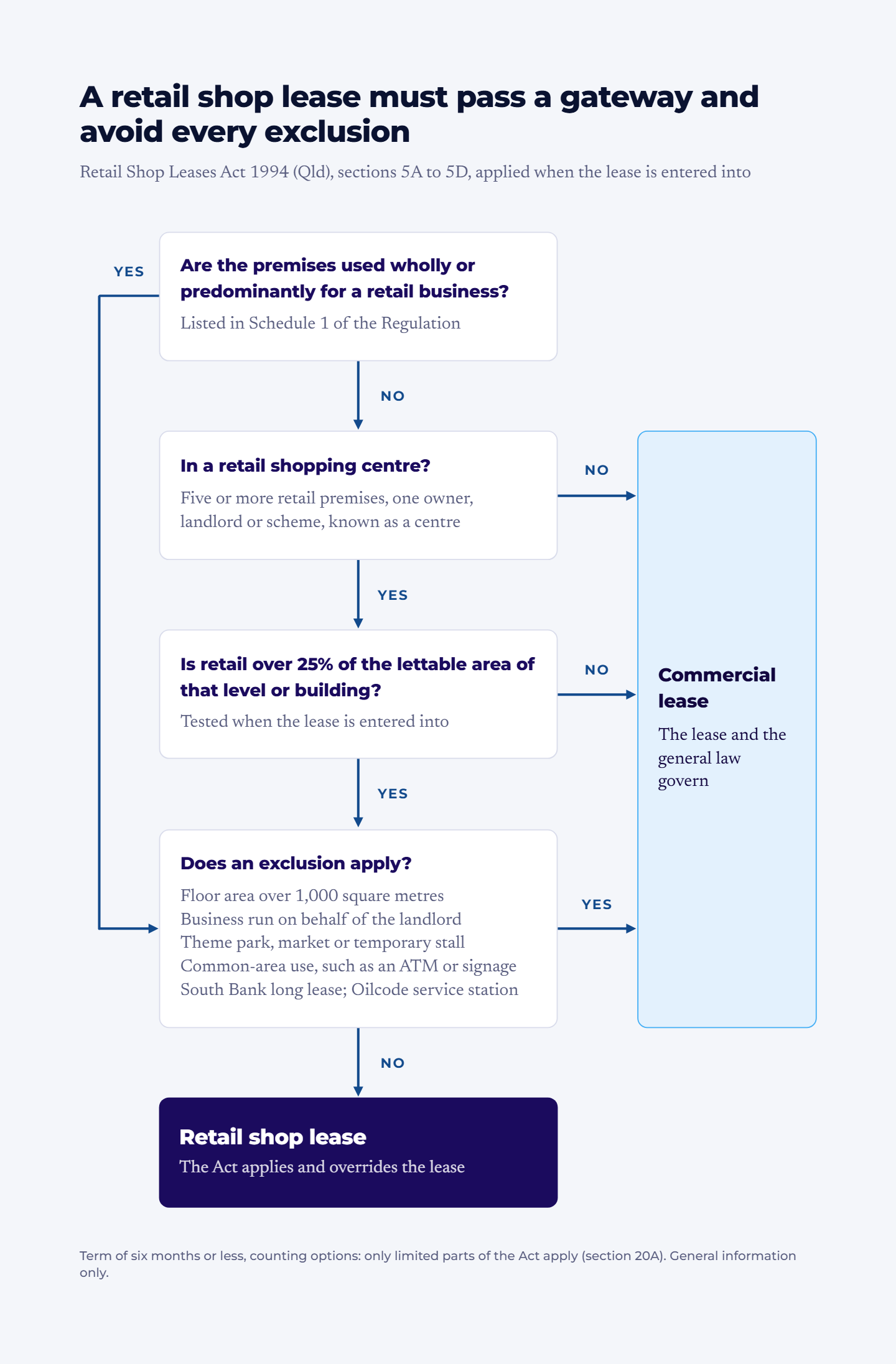
Either gateway brings a lease to the exclusions, and only a lease that clears both sets is a retail shop lease.
When the test is applied
The test is first applied when the lease is entered into, but in New South Wales the answer can change during the term.
Under section 8, a lease is entered into when the tenant takes possession or begins to pay rent, whichever happens first. If both parties sign before either event, the lease is entered into on signing.
A tenant who moves in or starts paying rent before the documents are signed has already entered into the lease. The landlord's disclosure statement was due at least seven days before that.
Section 8 is a rule about timing only. In Ausko Cooperation v Junapa Pty Ltd [2021] NSWSC 615, the Supreme Court said it fixes when a lease is taken to be entered into, not whether a binding lease exists.
The definition asks how premises are "used, or proposed to be used", so a later change of use can move a lease across the line. Dee-Tech Pty Limited v Neddam Holdings Pty Limited [2012] NSWSC 251 is the example (case note).
The premises in that case were let for computer sales and an internet café, and were a retail shop. They stopped being one after the permitted use was widened and a commercial laundry became the predominant use. The tenant lost the Act's outgoings protections as a result.
A request to change the permitted use, or to sublet part of the premises, is therefore also a question about the Act. Changes to the prescribed list are different, because section 84B preserves the status of existing leases.
The label does not decide the question. The Act operates despite the terms of the lease, and the parties cannot avoid it by agreement in the lease or elsewhere (section 7).
Retail shop lease and commercial lease compared
A retail shop tenant's protections come from the Act, while a commercial tenant has only what it negotiates into the lease. Section numbers refer to the Retail Leases Act 1994 unless another Act is named.
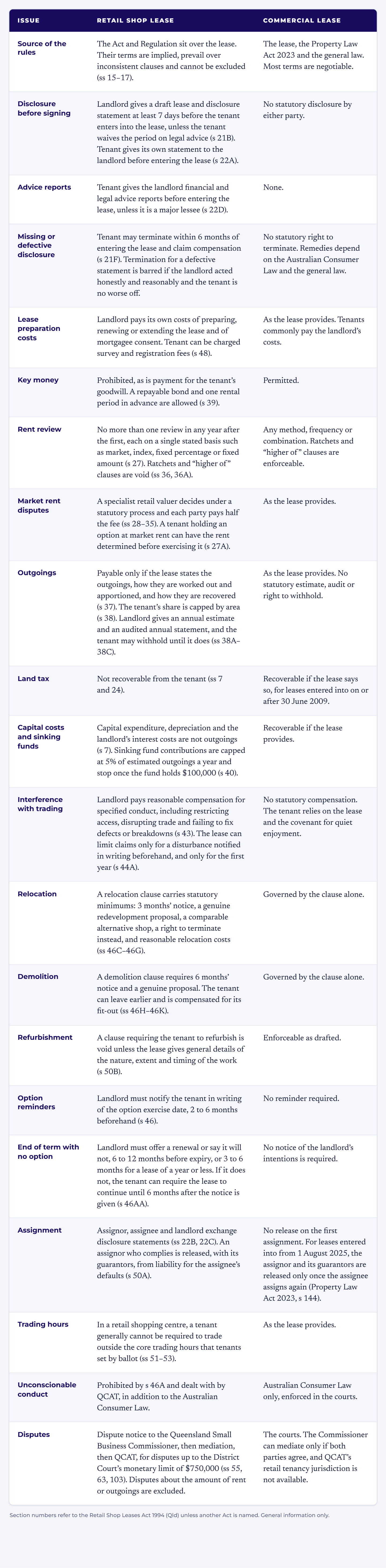
Some rules are common to both kinds of lease. The Australian Consumer Law prohibits misleading and unconscionable conduct, and unfair terms in standard form small business contracts.
The Conveyancing Act 1919 also applies to both. A landlord must give notice and a reasonable time to remedy before forfeiting for a breach other than unpaid rent (section 129). A landlord that wants to rely on a breach to refuse an option must serve a prescribed notice, and the tenant can ask the court for relief (sections 133E and 133F).
Neither kind of lease has a minimum term. The five-year minimum for retail shop leases was repealed from 1 July 2017.
The rules are about to change
Parliament has passed amendments to the Act that are not yet in force. The Retail Leases Amendment (Review) Bill 2025 passed both Houses on 17 November 2026 and was awaiting assent when this article was written. It will become the Retail Leases Amendment (Review) Act 2026 and will commence on a date set by proclamation.
The amendments look forward only. They will not apply to a lease entered into, or a disclosure statement given, before they commence.
One change moves the line described in this article. Schedule 1A will be repealed, and the excluded uses will be prescribed by regulation instead. An excluded use will stay inside the Act where it is ancillary to a retail shop and covered by the same lease, such as car parking, signage or storage (new sections 5(d) and 79).
Other changes affect the comparison table:
Disclosure. The parties will be able to shorten or waive the 7-day period in writing, if each has engaged a lawyer or licensed conveyancer and taken advice on doing so (new section 11). The tenant's termination right moves to a new section 11B, and the statement forms will no longer be set out in the Act.
Lease costs. A landlord will be able to recover reasonable lease preparation expenses where an existing lease could have been assigned but the parties agreed to a new lease instead (new section 14(4A)).
Outgoings audits. For a shop outside a shopping centre, the auditor's report will be prepared by a certified practising accountant rather than a registered company auditor (section 28).
Relocation. Rent for the alternative shop will be adjusted for differences in commercial value and for factors such as foot traffic, retail mix and road frontage (section 34A).
End of term. For a lease with an option, the landlord's notice period will be measured from the end of the renewed or extended term (section 44).
COVID-19. The pandemic provisions in Part 11 will be repealed.
The Bill gives effect to the first tranche of recommendations from the statutory review of the Act, so further amendments may follow.
This article is general information only and is not legal advice. It states the law as at 22 November 2026.
