
In Queensland, a lease is a retail shop lease because of where the premises are and how they are used, not because of what the document is called. If a lease meets the definition in the Retail Shop Leases Act 1994 (Qld), mandatory rules apply and the parties cannot contract out of them. If it does not, it is an ordinary commercial lease and the parties are largely held to the bargain they wrote.
The line matters because the two regimes allocate cost and risk differently. A retail landlord must give a disclosure statement before the lease is entered into, cannot pass on land tax or its lease preparation costs, and is limited in how rent can be reviewed. A commercial landlord faces none of those limits unless the lease says so.
This article explains where Queensland draws the line, then compares the two regimes issue by issue. It is the first in a series covering Queensland, New South Wales, Tasmania and Victoria.
When a lease is a retail shop lease
A lease is a retail shop lease if it is a lease of a "retail shop" and no exclusion applies (section 5A). Premises are a retail shop if they pass either of two tests in section 5B.
Gateway 1: the premises are in a retail shopping centre. The tenant's own business does not have to be retail. An accountant or a gym in a shopping centre can hold a retail shop lease, subject to the low-retail exclusion discussed below.
Gateway 2: the premises are used wholly or predominantly for a retail business. Location does not matter. A stand-alone café, or a hairdresser on the ground floor of an office tower, is a retail shop.
"Lease" is defined widely. It covers any agreement giving a right to occupy premises for value, whether or not the right is exclusive, and includes periodic tenancies and tenancies at will. Calling the document a licence does not take it outside the Act.
What makes a retail shopping centre
A cluster of premises is a retail shopping centre only if it has all four attributes in section 5D:
five or more of the premises are used wholly or predominantly for retail businesses;
all the premises have one owner, one landlord or head landlord, or are lots in a single community titles scheme;
all the premises are in one building, or in two or more buildings that adjoin or are separated only by common areas or a road; and
the cluster is promoted, or generally regarded, as a shopping centre, mall, court or arcade.
A row of four shops and a medical centre under one owner is not a retail shopping centre, because only four premises are retail. The four shops are still retail shops through gateway 2. The medical centre holds a commercial lease.
What counts as a retail business
A retail business is whatever the regulation prescribes (section 5C). Section 8 and Schedule 1 of the Retail Shop Leases Regulation 2016 list 26 categories. A business also qualifies if its whole or predominant activity is selling, hiring or supplying goods or services on that list.
The list covers what most people would call shops, plus some services:
Food: cafés, restaurants, takeaway, bakeries, butchers, greengrocers, supermarkets and convenience stores.
Goods: clothing, footwear, furniture, appliances, hardware, jewellery, toys, books, newsagencies, sporting goods, pharmacies and bottle shops.
Services: hairdressers, barbers, beauty salons, dry cleaning and laundry, key cutting, travel agencies and pet grooming.
The list is narrower than many people expect, and wholesaling is expressly excluded. The Queensland Small Business Commissioner treats gyms, medical centres, real estate agencies, car dealerships, tyre shops, offices, warehouses and bars or pubs serving liquor on the premises as non-retail. Outside a retail shopping centre, leases to those businesses are commercial leases.
Leases that fall outside the Act
Even where the premises are a retail shop, section 5A takes several kinds of lease outside the Act. If one applies, the lease is a commercial lease.
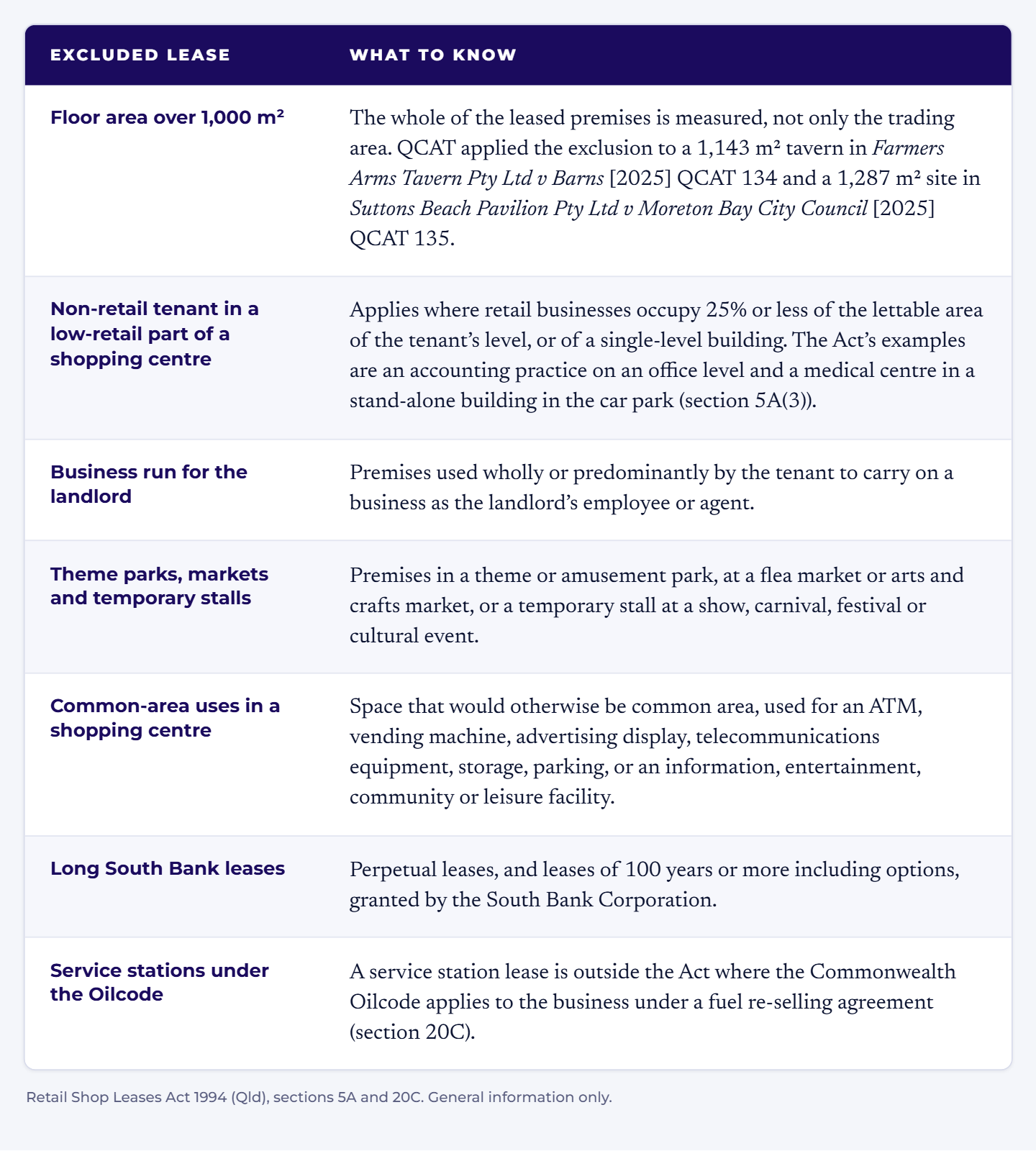
Three other situations leave the lease inside the Act but switch off parts of it:
Short-term leases. If the term plus any options totals six months or less, only the Act's preliminary, interpretation and trading-hours provisions apply (section 20A). The disclosure rules and minimum lease standards do not.
Periodic tenancies and tenancies at will. The disclosure regime in Part 5 does not apply (section 21).
Large and government tenants. A "major lessee", being a tenant of five or more retail shops in Australia, can opt out of the rent review rules and need not give advice reports. Government tenants are exempt from tenant disclosure and option reminders (section 20B).
Older leases keep their status. A lease that was a retail shop lease immediately before 25 November 2016 remains one, even if it would now be caught by the 1,000 m² or 25% exclusions (sections 152 and 154). Before that date, the floor area exclusion applied only where the tenant was a listed corporation or its subsidiary.
The test at a glance
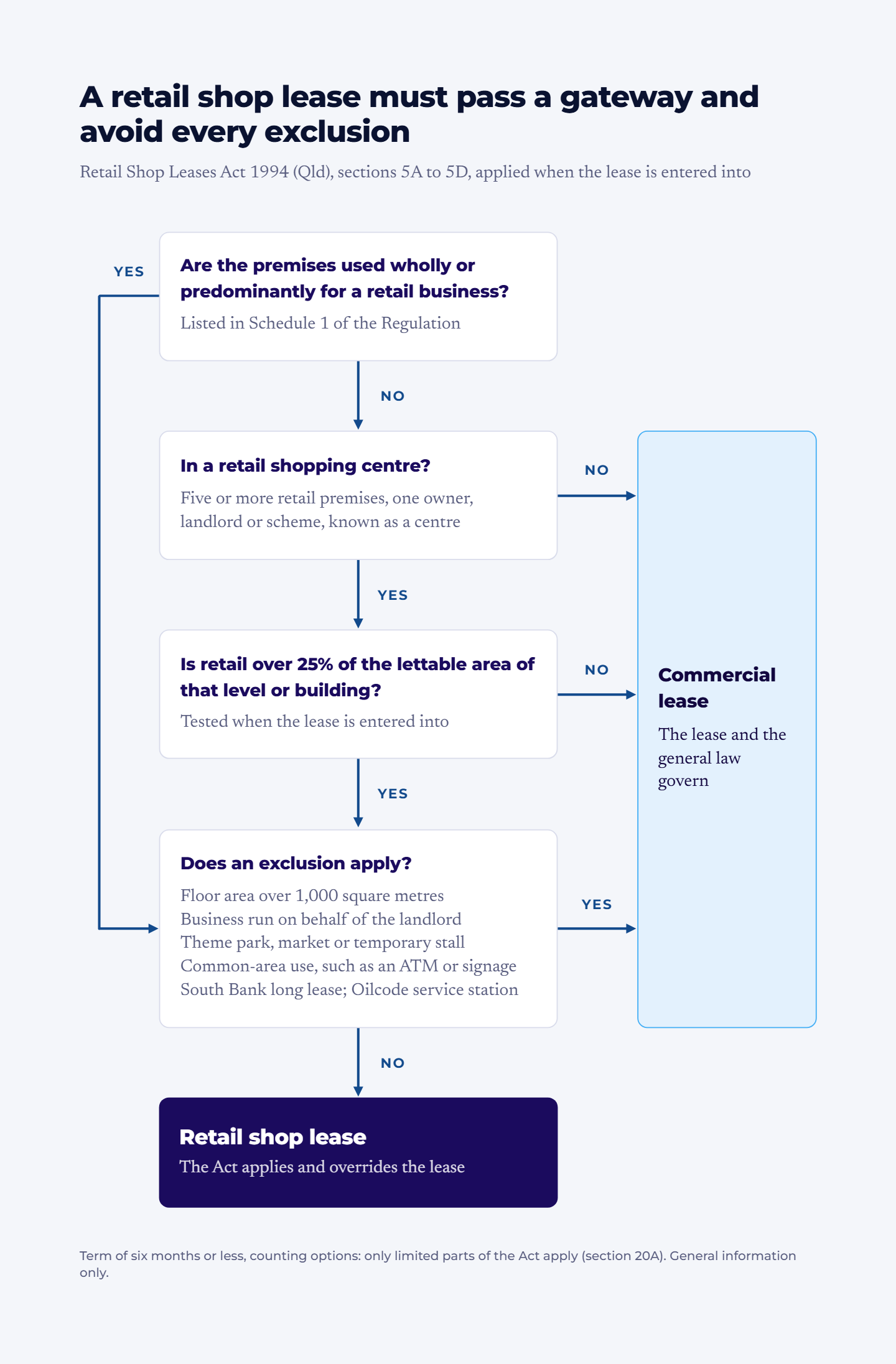
Either gateway brings a lease to the exclusions, and only a lease that clears them is a retail shop lease.
When the test is applied
The test is applied once, when the lease is entered into, and the answer holds for the life of that lease.
Under section 11, a lease is entered into on the earliest of three dates: when all parties have signed, when the tenant takes possession under the lease, or when the tenant first pays rent other than a holding deposit. A tenant who moves in or starts paying rent before the documents are signed has already entered into the lease. The landlord's disclosure statement was due at least seven days before that date.
Later changes do not move a lease across the line (section 14). If premises become a retail shop only after the lease is entered into, the Act does not apply to that lease, to an assignment of it, or to a renewal under an option in it. If premises stop being a retail shop, the Act keeps applying to the lease, an assignment and an option renewal.
So a commercial lease does not become a retail shop lease because the tenant's type of business is later added to the regulation. A retail shop lease does not lose its status because the cluster around it stops qualifying as a retail shopping centre. A fresh lease negotiated at expiry, rather than a renewal under an option, is a new lease and should be tested again at its own date.
The label does not decide the question either way. A term that tries to exclude the Act is void (section 16), and the Act applies whatever governing law the lease names (section 12). Equally, the parties cannot agree their way into the Act. In Mahadeo Property Investments Pty Ltd v Clinrad Goodna Pty Ltd [2026] QCAT 129, QCAT found that a radiology clinic's lease was not a retail shop lease, whatever the parties had believed (QSBC case note).
Retail shop lease and commercial lease compared
A retail shop tenant's protections come from the Act, while a commercial tenant has only what it negotiates into the lease. Section numbers refer to the Retail Shop Leases Act 1994 unless another Act is named.
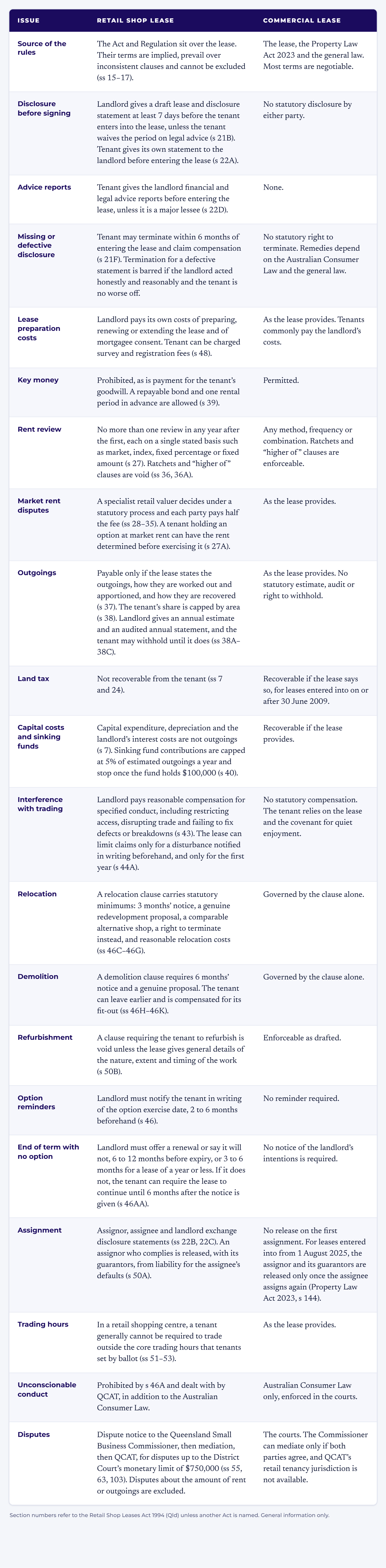
Some rules are common to both kinds of lease. The Australian Consumer Law prohibits misleading and unconscionable conduct, and unfair terms in standard form small business contracts. The Property Law Act 2023 gives a landlord one month to decide a consent request, bars unreasonable refusal, and requires an approved-form notice to remedy breach before forfeiture. Queensland sets no minimum term for either kind of lease, and neither regime regulates how a bond or bank guarantee is held.
The test may change
The Act is under statutory review, and its scope is one of the matters on the table. The Queensland Government's discussion paper raises refining the Act's scope for modern retail models, simplifying disclosure, and amending the minimum lease standards and dispute resolution provisions. Written submissions closed on 11 September 2026, and at the time of writing no recommendations or amending Bill had been published.
Separately, the Retail Shop Leases Regulation 2016, which holds the list of retail businesses, is due to expire on 1 September 2027 unless it is remade or extended. Either process could redraw the line described in this article.
This article is general information only and is not legal advice. It states the law as at 21 November 2026.
